
By PRO Seal & Paving | Pool Removal & Demolition | Genesee, Orleans & Wyoming Counties, NY
Your In-Ground Pool Is Quietly Draining Your Property Value — Here’s the Breakeven Point Every Western NY Homeowner Should Know
That in-ground pool sitting unused in your Genesee, Orleans, or Wyoming County backyard is not just a maintenance headache — it is a financial calculation that most homeowners run the wrong way. The real question is not what it cost to build. The real question is what it is costing you right now, this season, to keep it — and what happens to your property value and your liability exposure every year it sits there deteriorating instead of being properly removed and restored.
PRO Seal & Paving has performed in-ground pool removal across Western New York for over 17 years. Owner Josh Piscitelli has seen every variation of the old-pool problem — from cracked concrete shells to collapsed fiberglass vessels, from pools that haven’t been filled in a decade to ones that are still running on a failing system. The conclusion is always the same: the longer you wait, the more the removal costs, and the more you lose in the meantime.
The Real Numbers
What Keeping an Old In-Ground Pool Actually Costs Per Year
$1,200–$3,000
Annual maintenance, chemicals & repairs on a functioning pool
$500–$1,500
Insurance premium increase for pool liability coverage
5–15%
Potential reduction in buyer pool in Western NY’s climate
Why Western New York Is Not Pool Country — And What That Means for Removal ROI
Unlike Florida or Arizona where pools add consistent value and get year-round use, Western New York pools face a brutal reality: a three to four month functional season, aggressive winter freeze-thaw cycles that crack concrete shells, and a buyer market that overwhelmingly prefers usable yard space over a pool requiring annual opening and closing costs. In Genesee, Orleans, and Wyoming Counties, an old or non-functioning in-ground pool frequently subtracts from assessed value rather than adding to it.
When a pool shell cracks, shifts, or begins to collapse, the liability stakes rise dramatically. A collapsed pool that has been abandoned represents an attractive nuisance under New York property law — meaning the property owner can face liability if a child or trespasser is injured, regardless of whether the pool was in use. That exposure is eliminated the moment proper pool demolition and site restoration is complete.
Understanding Your In-Ground Pool Removal Options
Full Pool Removal (Complete Excavation)
The entire pool shell — whether concrete, gunite, fiberglass, or vinyl-lined steel — is broken up, extracted, and hauled from the site. The excavation is then backfilled with compacted structural fill material, graded to match the surrounding yard, and restored to usable surface. Full removal is the right choice when property owners want to build over the area in the future, maximize yard space, or ensure the most favorable outcome on resale.
Partial Pool Removal (Abandonment Fill)
The pool walls are punctured at the base for drainage, the top section of the shell is broken down several feet below grade, and the void is filled with rubble and compacted fill. This method costs less upfront but requires disclosure in any future property sale and restricts what can be built over the site. It is typically used when full removal cost is prohibitive and no future building over the area is planned.
Deck and Coping Removal
In many cases, the concrete or paver deck surrounding the pool is also removed as part of the project. Removing the deck alongside the pool shell creates a clean site for new lawn, garden beds, patio installation, or asphalt/concrete surfacing — often in the same project scope.
“In over 17 years of demolition work across Genesee, Orleans, and Wyoming Counties, I’ve never had a homeowner regret removing an old in-ground pool. I’ve had many who regretted waiting.” — Josh Piscitelli, Owner, PRO Seal & Paving
The PRO Seal & Paving In-Ground Pool Removal Process
Step 1: Site Assessment & Permitting
We evaluate the pool construction type, site access, utility locations, and permit requirements. Most pool removals in New York State require a demolition permit, which we handle for you.
Step 2: Water Removal & Utility Disconnection
Any remaining water is pumped and properly disposed of. Pool electrical, plumbing, and gas lines are identified, disconnected, and capped to code before demolition begins.
Step 3: Shell Demolition & Extraction
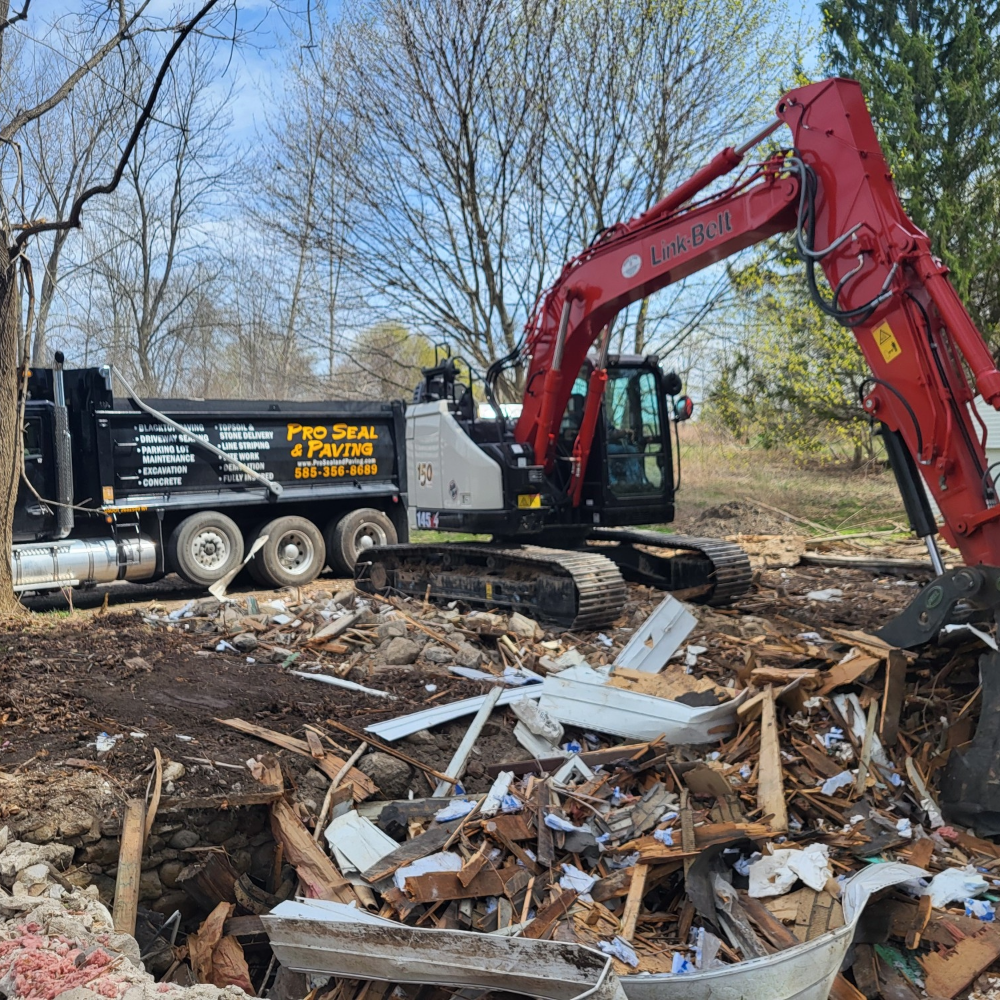
Concrete, gunite, or fiberglass shells are broken using hydraulic excavators and removed from the site. Deck and coping demolition can be performed simultaneously.
Step 4: Backfill & Compaction
The excavated void is filled with clean structural fill, compacted in lifts to prevent future settlement. Proper compaction is critical — shortcuts here create sinkholes and yard depressions years later.
Step 5: Grading & Site Restoration
The restored area is graded to match surrounding yard elevation, topsoil is placed, and the site is seeded or prepared for paving, concrete, or landscaping per the homeowner’s plan.
Step 6: Debris Hauling & Cleanup
All broken concrete, fiberglass, steel, and related materials are hauled from your property. We leave your site clean, graded, and ready for whatever comes next.
Types of In-Ground Pools We Remove
- Concrete and gunite pools — the most common type in Western NY; broken with excavation equipment and removed in sections
- Fiberglass pools — lifted out as a single shell (when intact) or broken in place if access is limited
- Vinyl-lined steel or aluminum frame pools — frame, liner, and surrounding concrete deck removed as a complete package
- Natural stone or tile-lined pools — complete demolition including decorative elements, coping, and decking
- Spas and hot tub shells — often combined with adjacent pool removal for a single-project outcome
Related Demolition Resources from PRO Seal & Paving
PRO SEAL & PAVING — WESTERN NEW YORK
Ready to Reclaim Your Backyard? Let’s Remove That Pool.
PRO Seal & Paving handles in-ground pool removal across Genesee, Orleans, and Wyoming Counties — from initial permit to final grading. Free on-site estimates. No obligation.
Get a Free Estimate
Call 585-356-8689
✓ Licensed & Insured ✓ Permit Assistance Included ✓ Full Backfill & Site Restoration ✓ Free Estimates
Frequently Asked Questions About In-Ground Pool Removal in Western New York
How long does in-ground pool removal take in Genesee County?
Most residential in-ground pool removal projects in Genesee, Orleans, and Wyoming Counties take two to four days from mobilization through final grading, depending on pool size, shell material, and site access conditions. Concrete and gunite pools require more time than fiberglass shells. We give you a specific timeline at the free estimate visit.
Do I need a permit to remove an in-ground pool in New York State?
Yes. In-ground pool removal typically requires a demolition permit in New York State municipalities. PRO Seal & Paving handles the permit process as part of every pool removal project — you do not need to navigate local building departments on your own. We submit the paperwork and schedule inspections as required.
What happens to the ground after pool removal? Will it sink?
With proper backfill and compaction, sinking is not a concern. We fill the excavated void in compacted lifts using structural fill material, which prevents the settlement that causes sinkholes. Shortcuts in this step — using loose fill or non-structural debris — are the cause of settling problems years after removal. Our backfill process is thorough specifically to prevent this outcome.
Will removing my in-ground pool increase my home’s value in Western New York?
In most cases, yes — particularly in Genesee, Orleans, and Wyoming Counties where the short pool season and high maintenance costs make pools less desirable to buyers than in warmer markets. Removing a non-functional or aging pool eliminates a liability, restores usable yard space, and removes a maintenance concern that many buyers in this climate use to negotiate prices down.
Can the area where the pool was be paved or built on after removal?
Yes — with full pool removal and proper compaction, the restored area can support future paving, concrete flatwork, or construction. Partial fill methods (abandonment) restrict future building over the site and require disclosure in property sales. We discuss which removal method aligns with your future plans during the estimate visit.