
BLUF:
If you’re a homeowner in Genesee County, NY, eyeing land purchase or development for a new home, installing a septic system, sewer line, or main water line often requires excavation and it’s not as straightforward as it might seem. Research suggests that proper planning can prevent costly issues like system failures or regulatory fines, but complexities arise from local soil variations, environmental protections, and permitting processes. It seems likely that hiring a professional excavator is essential to navigate these safely and compliantly, though some might consider DIY approaches in non-regulated areas.
KEY TAKE AWAY:
Homeowners in Genesee County must obtain permits, evaluate soil percolation, and follow environmental and safety regulations before installing septic systems, sewer lines, or water mains. Professional excavation is recommended to ensure compliance with county, state, and environmental standards while avoiding system failure or fines.
Table of Contents
Your Guide to Excavation for Utilities in Genesee County Home Development
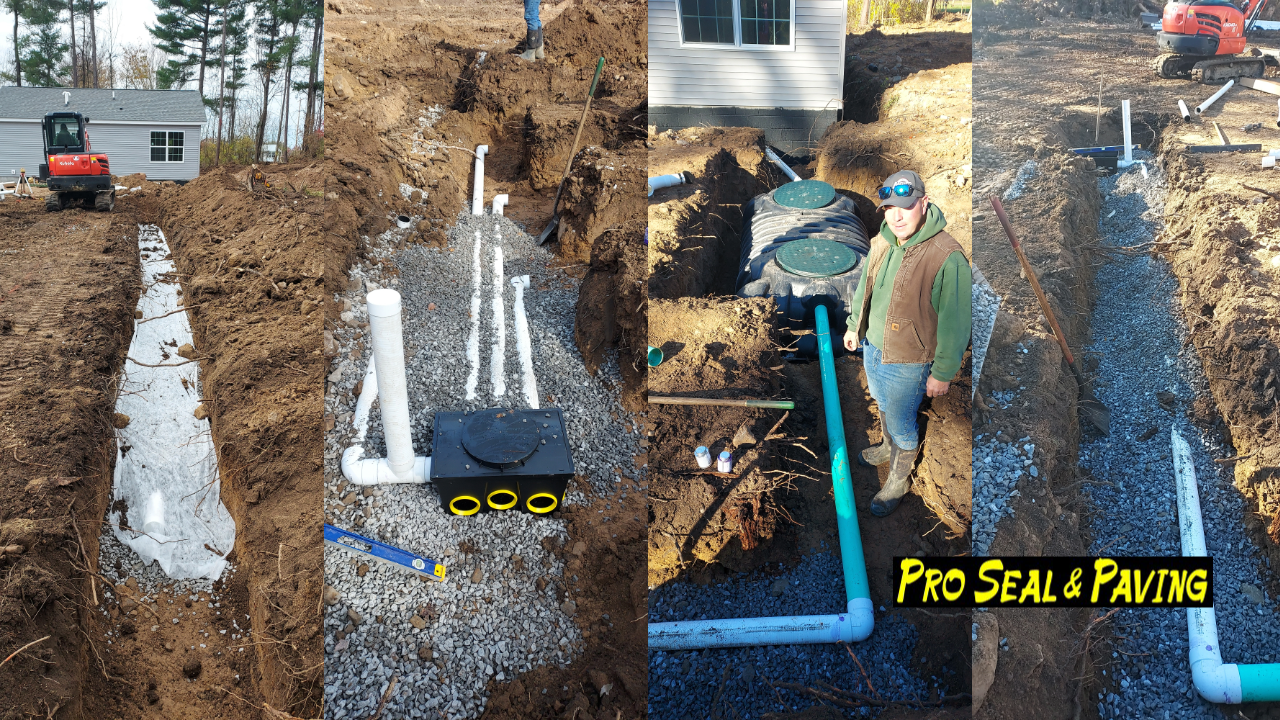
Hey there, I’m Josh Piscitelli, and at Pro Seal & Paving, we’ve handled countless excavation jobs across Genesee County, from bustling Batavia to rural gems like Elba and Basom. If you’re planning to buy land or build a home, odds are you’ll need to install or upgrade a septic system, sewer line, or water main.
These aren’t just plumbing tasks; they require deep excavation, and skimping on details can lead to headaches like failed inspections or environmental issues. Let’s dive into what you should consider, why professional help is non-negotiable, and how it all ties into land development in our neck of the woods.
Key Points
- Regulatory Compliance is Crucial: Evidence points to the need for permits from the Genesee County Health Department for septic systems and from Public Works for any right-of-way work, with state standards (such as Appendix 75-A) dictating design to avoid contamination.
- Soil and Site Variability Adds Challenges: Soils in the area, such as well-drained Genesee silt loam or somewhat poorly drained Burdett channery silt loam, influence percolation and excavation stability; perc tests are often required, highlighting potential controversies over site suitability in flood-prone or wetland areas.
- Environmental Protections Balance Development: The county’s Smart Growth Plan emphasizes preserving agricultural land and mitigating impacts on wetlands and waterways, acknowledging debates around growth versus conservation.
- Professional Expertise Mitigates Risks: Hiring a licensed excavator ensures adherence to safety standards, proper utility locating, and efficient handling of heavy equipment, reducing liabilities that could affect all stakeholders, from homeowners to local ecosystems.
Chapter 1: Understanding the Basics of Septic, Sewer, and Water Line Installations
First off, why do these matter for homeowners? In Genesee County, not every property hooks into the city sewer or water, especially in towns like Pavilion, Darien, or Stafford. If you’re building in Alabama or Indian Falls, a septic system might be your go-to for wastewater. Sewer lines connect to municipal systems (standard in Batavia or Le Roy), and water mains bring in a clean supply. All involve digging trenches, laying pipes, and backfilling, but the devil’s in the details.
Septic Systems: From Planning to Installation
Septic systems treat household wastewater onsite, using a tank and absorption field. In Genesee County, the Health Department oversees this and requires permits before you start. You’ll need a percolation (perc) test to assess soil absorption: dig holes, fill them with water, and measure drainage rates. State regs under Appendix 75-A set the standards: tanks must hold at least 1,000 gallons for a 3-bedroom home, with baffles to trap solids, and absorption trenches must be 2 feet from groundwater. Sites with slopes over 15% or flood risks? Forget it, they’re unsuitable.
Consider this: In areas like Bergen or Byron, where soils may be silty, poor drainage could require a larger field or an enhanced treatment unit (ETU) for better filtration. Homeowners, plan for a 50% expansion area in case of future needs, and keep systems 100 feet from wells to avoid contamination. Inspections happen during install and property transfers—skip them, and you’re looking at fines.
Sewer Lines: Connecting to Municipal Systems
If your land is near a village such as Oakfield or Corfu, connecting to the public sewer may be feasible. However, excavation here requires coordination with local utilities. Permits are issued by the county or town; for example, in Batavia, applications go through the city, with rules on pipe materials (e.g., ductile iron for larger lines). Trenches must be deep enough (at least 4 feet) to prevent freezing and backfilled with compacted stone to prevent settlement.
One big consideration: If crossing county roads, you’ll need a right-of-way permit from Public Works. Utilities such as sewer pipes extend beyond ditch lines, with a minimum cover of 36 inches. In Le Roy, street excavations require insurance and fencing to protect the public.
Main Water Lines: Ensuring Reliable Supply
Water lines are critical for any home build. In Genesee County, the ongoing Water Supply Project expands access, but hook-ups are restricted under the Smart Growth Plan to preserve ag land. Pipes must be Type K copper or equivalent, at least 3/4-inch diameter, buried 4 feet deep. Keep 10 feet from septic systems to prevent cross-contamination.
For developments in Alexander or East Pembroke, check if you’re in a designated area—otherwise, apply for special authorization. Excavation might involve boring under roads to minimize disruption.
Chapter 2: Soil and Site Considerations in Genesee County
Genesee County’s soils vary, impacting how easy (or hard) excavation is and whether your site suits a septic system. From USDA surveys, here’s a breakdown:
| Soil Type | Description | Implications for Excavation and Utilities |
|---|---|---|
| Genesee silt loam | Very deep, well-drained, formed in alluvium on floodplains; slopes 0-2%. | Good for septic (high percolation), but flood risks mean extra wetland checks; stable for digging but watch for water table. |
| Hilton loam | Very deep, moderately well-drained, from till of sandstone/limestone. | Moderate drainage suits absorption fields; potential frost heave in winter excavations—pros use shoring to prevent collapses. |
| Nunda silt loam | Deep, moderately well-drained, silty mantle over till from shale. | Slower perc in clayey layers; may need larger fields or amendments; compaction risks during wet digs. |
| Burdett channery silt loam | Very deep, somewhat poorly drained, from shale-dominated till. | Poor drainage could fail perc tests; unsuitable for standard septic without ETUs; excavation prone to slumping in wet conditions. |
These soils underscore why a perc test is mandatory. Rates of 1-60 min/inch are usable, but faster means blending with slower soils. In floodplains (common in South Byron or Pearl Creek), avoid building to prevent erosion. I’ve seen projects in Fancher halted due to high water tables—always get a soil eval first.
Slope, Depth, and Bedrock Factors
Most sites have gentle slopes (0-10%), but steeper ones in Bushville require erosion controls. Bedrock is usually >6 feet deep, but if shallower, blasting might be needed (rare, but pros handle permits). Groundwater varies—<3 feet in some spots demands raised systems.
Chapter 3: Environmental and Regulatory Factors for Land Development
Genesee County’s Smart Growth Plan is a game-changer, mitigating the impacts of water projects by limiting hook-ups outside designated areas to protect farms and wetlands. For home building in Elba or West Pembroke, this means checking if your land qualifies; ag districts often have restrictions.
Wetlands, Floodplains, and SEQR Reviews
Projects disturbing >1 acre need a Stormwater Pollution Prevention Plan (SWPPP) under SPDES permits to control runoff and siltation. Wetlands (e.g., Class I or II) require NYSDEC/USACE approvals if encroached—common in Darien or Bergen. Floodplains? No building below 10-year levels, and maintain buffers to streams like Black Creek.
SEQR assesses impacts: temporary turbidity from digging, habitat disruption (e.g., for endangered species like Northern Long-eared Bat), and air/noise during construction. Mitigation includes timing tree clearing (Oct-Mar) and restoring sites post-dig.
Building Permits and Town-Specific Rules
Home construction needs town permits—e.g., Batavia requires zoning reviews and inspections. In Le Roy, open excavations over 30 days must be fenced 5 feet high. County-wide, right-of-way work demands insurance ($1M liability) and traffic plans. For Oakfield or Corfu, village codes might add sewer extension apps.
| Town/Area | Key Consideration |
|---|---|
| Batavia/City of Batavia | Water pipes ≥3/4″ dia., 4-ft depth; separate from septic by 10 ft. |
| Le Roy/Town of Le Roy | Street digs need $10K-$20K insurance; fence dangerous excavations. |
| Oakfield/Corfu | Sewer extensions approved by department; coordinate with health for septic alternatives. |
| Byron/Pavilion | Ag-focused; Smart Growth limits water hook-ups to preserve farmland. |
| Darien/Bergen | Wetland-heavy; extra permits for any stream crossings. |
| Stafford/Alabama | Soil perc critical due to variable drainage; floodplain checks. |
| Elba/Alexander | Rural sites often need full septic; environmental reviews for habitats. |
| Indian Falls/South Byron | Flood risks high; elevated systems or municipal ties preferred. |
| East Pembroke/West Pembroke | Proximity to creeks means erosion controls mandatory. |
| Fancher/Little Batavia | Utility boring under roads to avoid open cuts. |
| Bushville/Pearl Creek | Steeper slopes; shoring for trench stability. |
| Basom | Tribal lands nearby? Consult for cultural impacts, though not always required. |
Chapter 4: Why You Need to Hire a Professional Excavator
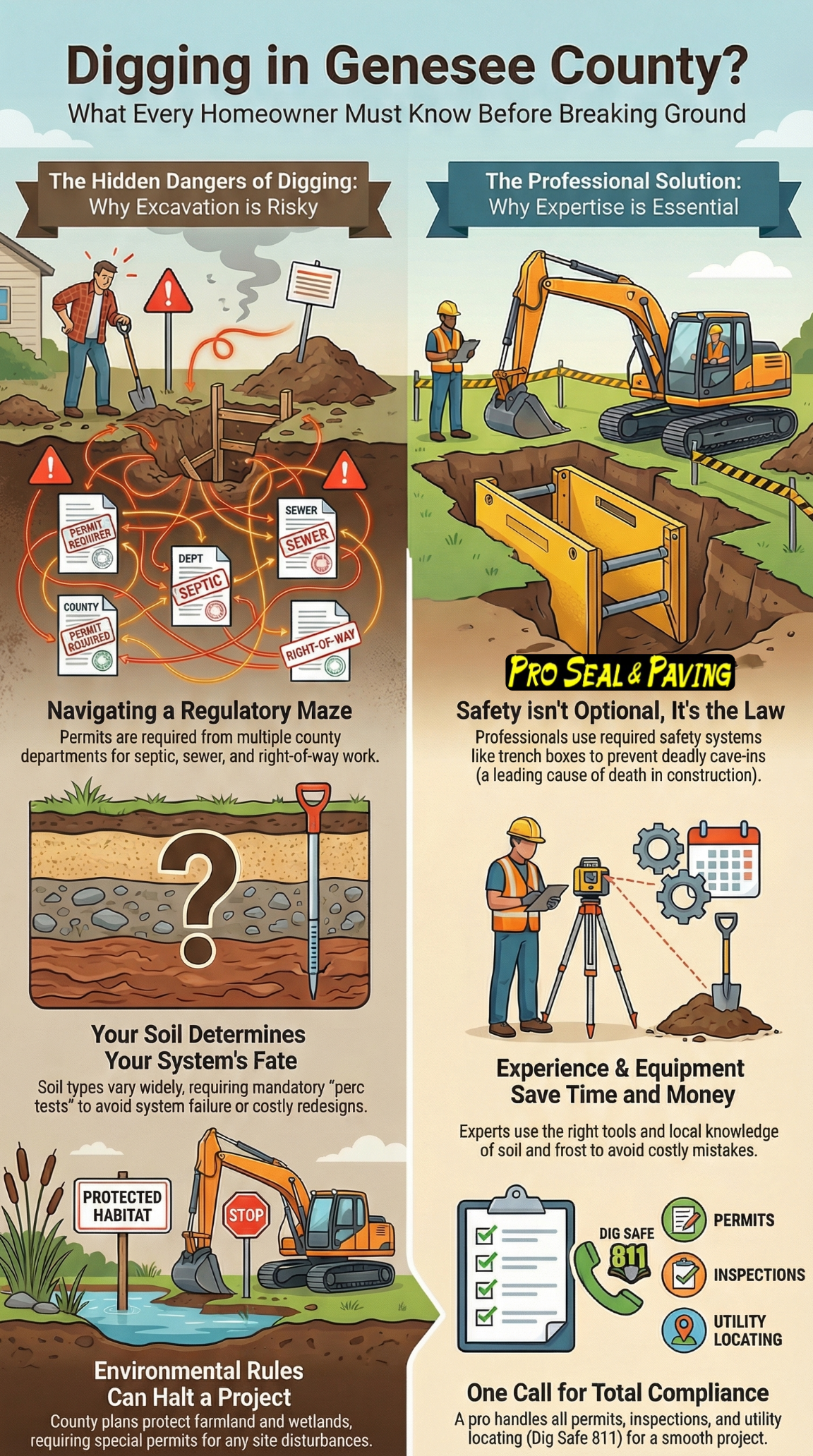
As someone who has spent years in the trenches, literally, I cannot stress this enough. Excavating for septic systems, sewer lines, or main water lines is not a weekend project. It is one of the most failure-prone phases of home development, and it is where most long-term problems begin. When excavation goes wrong it does not just delay a project. It can compromise structural stability, contaminate groundwater, trigger fines, or force a complete system rebuild.
OSHA classifies soil into three primary categories: Type A, Type B, and Type C. Type A soils, like dense clay, are the most stable, but even they can fail when saturated. Type B and C soils, which are common throughout Genesee County, are far more unpredictable, especially after rain or snowmelt. Without proper soil evaluation, trench walls can collapse in seconds. This is not theory. Cave-ins are one of the leading causes of serious injury and death in construction nationwide.
Professional excavators understand soil behavior, groundwater movement, trench geometry, and load pressures. At Pro Seal and Paving we do not guess. We evaluate soil conditions, adjust trench angles, use shoring or shielding when required, and follow strict safety protocols on every job. We also contact Dig Safe 811 before any excavation begins, so underground utilities are located and marked. Hitting a gas, electric, or fiber line is not just expensive. It can be catastrophic.
Safety and Compliance
Once an excavation reaches five feet in depth, protective systems are required by law. That includes sloping benching, trench boxes, or hydraulic shoring, depending on soil type and site conditions. These are not optional and they are not easy to implement without experience and equipment.
New York regulations are strict and enforcement is real. Improper excavation can result in stop-work orders, failed inspections, and fines that can reach $1,000 per day. In some cases, improperly installed systems must be completely removed and rebuilt at the homeowner’s expense.
A professional excavator ensures compliance with state, county, and local codes from day one. We coordinate permits, inspections, and right-of-way requirements so nothing falls through the cracks. That means fewer delays, fewer surprises, and a smoother path to final approval.
Efficiency and Cost Savings
Many homeowners assume DIY excavation saves money. In reality, it usually costs more. Rental equipment is expensive and often inadequate for utility depth excavation. One mistake can damage an existing line collapse a trench or require additional soil testing and rework.
Professional excavators use the right equipment for the job, including trenchers, excavators, and hydro excavation when precision is required. Hydro excavation allows us to safely expose utilities without damaging them which is critical when tying into existing sewer or water infrastructure.
Local experience matters. Genesee County has unique conditions, including seasonal high groundwater, wet spring soils, and variable frost depths. Knowing when to dig, how deep to go, and how to manage water intrusion can save days or weeks of downtime. That translates directly into lower overall project costs.
Environmental and Long-Term Benefits
Excavation impacts more than just your property. Improper trenching can cause erosion sediment runoff and wetland violations. Soil displacement near streams, floodplains, or agricultural land is closely regulated in Genesee County.
Professional excavators properly manage spoils, stabilize disturbed areas, and restore grades to prevent future drainage problems. We understand buffer requirements and environmental constraints and we know when rerouting a trench is the most innovative and safest option.
We have helped homeowners in towns like Stafford avoid wetland violations and costly penalties simply by adjusting trench paths and excavation methods before digging began. That kind of foresight protects both the homeowner and the surrounding environment.
The Bottom Line
Excavation is the foundation of your septic sewer or water system. If it is done wrong, everything above it is at risk. Hiring a professional excavator is not just about convenience. It is about safety compliance efficiency and protecting your investment for decades to come.
At Pro Seal and Paving, we bring local knowledge, proper equipment, and real-world experience to every excavation project. We do it right the first time so you do not pay for it twice.
Final Thoughts on Home Building in Genesee County
Developing land here is rewarding, but start with the pros. At Pro Seal & Paving, we’re your partners, from site evals to final backfill.
Contact us for a consultation, and let’s make your project go smoothly. Remember, thorough planning beats costly fixes every time.
✔ Local Genesee County experience
✔ Permit and soil compliance handled
✔ Residential and rural excavation specialists
✔ Trusted by homeowners for over 17 years
Call PRO Seal & Paving today and build with confidence.
Key Citations
- Private Water Wells & Septic Systems – Genesee County, New York
- Permits – Genesee County, New York
- Smart Growth Plan – Genesee County, New York
- Septic Systems – New York State Department of Health
- Town of Batavia, NY Water
- USDA Soil Series Descriptions (Genesee, Hilton, Nunda, Burdett)
- Classification of Soils for Excavations – OSHA
- What to Know About Excavating for Septic Systems and Drain Fields

Owner of PRO SEAL & PAVING
17+ years experience