
BLUF:
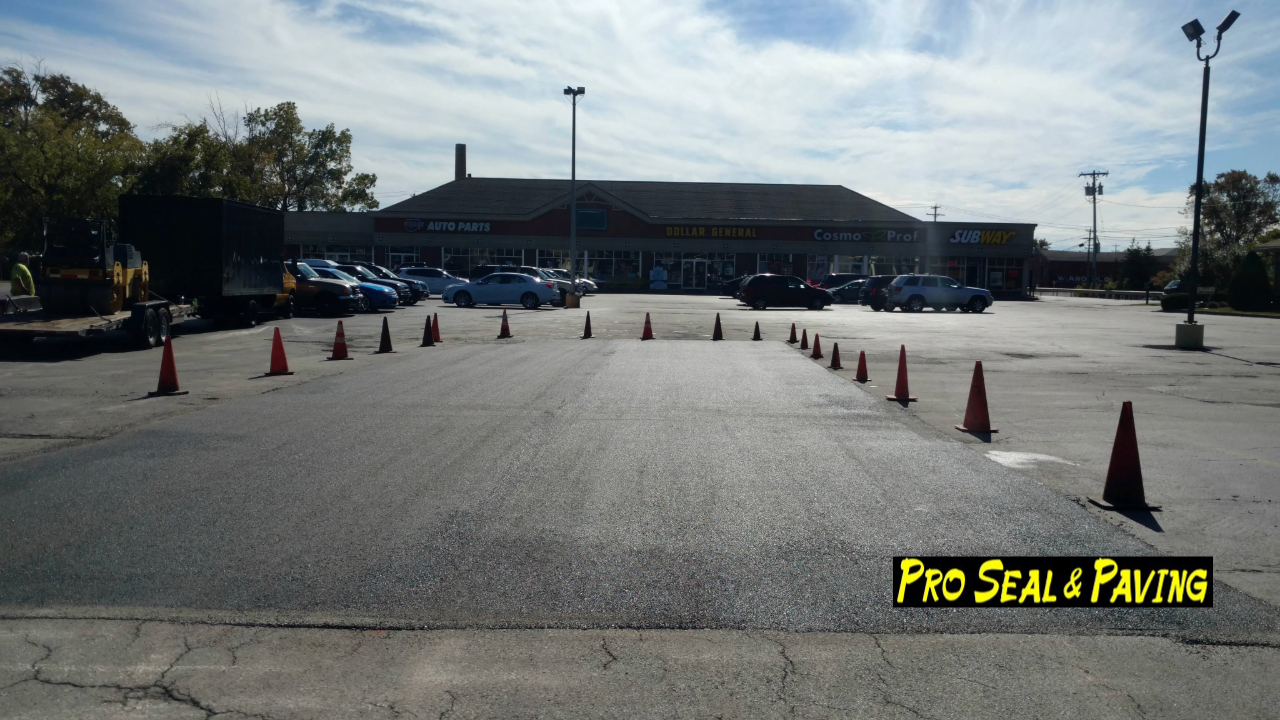
A well-maintained parking lot is about more than looks; it’s a critical safety system that prevents injury, vehicle damage, and costly lawsuits. Neglected pavement with potholes, cracks, and faded striping creates immediate liability for business owners in Genesee, Orleans, and Wyoming counties. Investing in professional paving, sealing, and striping is a proactive financial strategy that reduces insurance risk, ensures compliance, and protects your brand reputation.
Table of Contents
- Introduction: A Paving Contractor’s Perspective
- Chapter 1: Personal Injury Risks from Potholes and Cracks
- Chapter 2: Vehicle Damage and Traffic Accident Risk
- Chapter 3: Legal and Financial Consequences of Neglect
- Chapter 4: Insurance Liability and Risk Management
- Chapter 5: Why Proper Striping and Signage Matter
- Chapter 6: How Professional Paving Services Solve These Problems
- Chapter 7: Choosing the Right Paving Contractor in Western New York
- Call to Action
A Paving Contractor’s Perspective
My name is Joshua Piscitelli, and I own Pro Seal & Paving here in Western New York. For years, my team and I have helped business owners and property managers across Genesee, Orleans, and Wyoming counties keep their parking lots and driveways safe, functional, and professional.
One lesson stands out above all others. A well-maintained parking lot is not just about appearance. It is about safety, liability, and the message you send before a customer ever walks through your door.
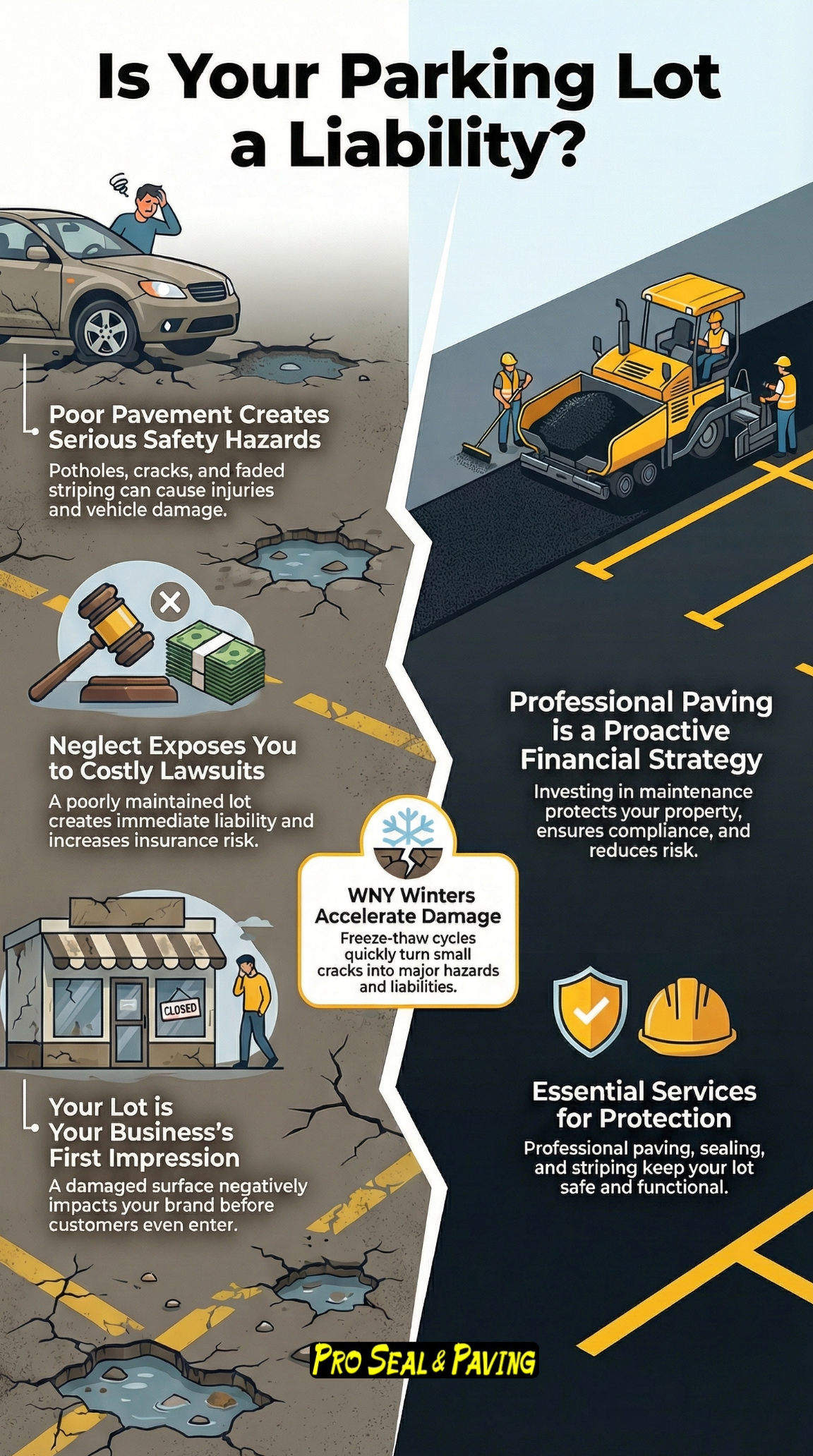
Your parking lot is often the first physical interaction someone has with your business. If that surface is full of potholes, cracked pavement, faded striping, or missing signage, it poses an immediate risk. County and municipal officials consistently point out that infrastructure quality directly affects safety and quality of life. Parking lots are no exception.
Western New York winters accelerate pavement damage. Freeze-thaw cycles, snowplows, salt, and heavy moisture turn small cracks into serious hazards fast. What looks minor in the fall can become a liability by spring. This article explains why neglected pavement is dangerous, how it exposes you financially, and how professional paving services can protect your property and your business.
Chapter 1: Personal Injury Risks from Potholes and Cracks
Potholes and cracked pavement are not cosmetic problems. They are active hazards.
Parking lots are one of the most common locations for outdoor slip-and-fall injuries. Uneven surfaces cause trips, ankle injuries, broken bones, and head trauma. Snow and ice exacerbate these risks by obscuring cracks and depressions that are not visible.
For business owners, the risk is serious. Medical costs from a single fall can reach tens of thousands of dollars. New York property maintenance standards require parking areas, sidewalks, and walkways to be kept free from hazardous conditions. If a known defect is ignored, liability becomes very real.
I have personally seen situations where a cracked pavement section led to an injury, a shaken business owner, and a legal issue that could have been avoided with timely repairs.
The takeaway is simple. If you see cracks or potholes forming, address them promptly. Waiting increases both injury risk and repair cost.
Chapter 2: Vehicle Damage and Traffic Accident Risk
Pedestrians are not the only ones affected by bad pavement. Vehicles suffer too.
Deep potholes damage tires, rims, and suspension systems. Drivers instinctively swerve to avoid pavement defects, which increases collision risk in busy lots. Poorly marked or unstriped parking areas compound the problem by creating confusion about traffic flow and parking boundaries.
Nationwide data consistently shows tens of thousands of crashes occur in parking lots every year, many tied to poor layout and surface conditions. When an accident happens on your property, even indirectly, it becomes your problem to manage.
Maintaining a smooth driving surface and clear striping keeps drivers predictable. Predictable movement reduces accidents.
Chapter 3: Legal and Financial Consequences of Neglect
From a legal standpoint, parking lots fall under premises liability. If an owner knew or should have known about a hazard and failed to fix it, responsibility follows.
Lawsuits are expensive even when insurance is involved. Claims raise premiums, affect coverage renewals, and can follow a business for years. A small maintenance bill is insignificant compared to the long-term cost of litigation or insurance increases.
Neglected pavement also hurts reputation. Customers notice unsafe or poorly maintained properties. Employees notice too, and unsafe conditions can lead to complaints or workers’ compensation claims.
The math always favors prevention.
Chapter 4: Insurance Liability and Risk Management
Insurance companies evaluate risk constantly. Parking lots with visible hazards are red flags.
Multiple slip-and-fall claims or vehicle damage incidents can lead to higher premiums, policy restrictions, or non-renewal. Insurers often require documented maintenance to maintain favorable coverage.
Parking lots are considered part of the workplace. If an employee is injured due to pavement conditions, workers’ compensation applies and long-term costs rise.
Fixing hazards before an incident is one of the most effective loss control strategies available to property owners.
Chapter 5: Why Proper Striping and Signage Matter in Orleans, Wyoming, and Genesee Counties
In Orleans County, Wyoming County, and Genesee County, parking lot striping and signage are not decorative details. They are safety systems that protect people, reduce liability, and keep businesses compliant with state and federal requirements.
Across Western New York, seasonal weather takes a heavy toll on pavement markings. Snowplows scrape paint, salt accelerates fading, and freeze-thaw cycles break down asphalt edges. When striping fades or signage disappears, confusion replaces order. Drivers guess where to park. Pedestrians cross unpredictably. Emergency access becomes compromised. Improvisation leads directly to accidents.
Clear, well-maintained markings create structure in busy parking environments, especially at retail centers, medical offices, schools, municipal buildings, and industrial sites throughout these counties.
Clear Striping Defines Safe Movement
Proper striping establishes predictable behavior for both drivers and pedestrians. Parking space lines keep vehicles aligned and prevent encroachment into drive aisles. Directional arrows control traffic flow and reduce head-on conflicts. Crosswalks guide foot traffic away from moving vehicles. Fire lanes remain unobstructed.
When these markings fade, drivers create their own patterns. Cars park crookedly or too close together. Drive aisles narrow over time. Pedestrians walk wherever feels safest, often in the most dangerous areas. This lack of structure increases the risk of collisions and makes property owners vulnerable to claims.
In high traffic areas common throughout Orleans, Wyoming, and Genesee Counties, predictable movement is essential.
ADA Compliance
Public-facing businesses in all three counties must comply with Americans with Disabilities Act parking requirements. These rules apply to parking lots serving customers, patients, tenants, and visitors.
Compliance includes:
- The correct number of accessible parking spaces based on the total space count
- Proper space width and access aisle dimensions
- Clearly visible pavement markings
- Correctly mounted signage at the required height
- Van accessible space designation where required
Faded paint, missing wheelchair symbols, worn access aisle striping, or damaged signs can put a property out of compliance, even if the original layout was correct. This exposes owners to enforcement actions, complaints, and potential legal claims.
Routine restriping ensures accessible parking remains visible, usable, and compliant year-round.
Traffic Flow and Emergency Access
Parking lots function like small road systems. Without guidance, they fail.
Directional arrows, stop bars, yield markings, and entrance/exit indicators control traffic movement and reduce confusion. Fire lane striping and signage ensure emergency responders can reach buildings quickly when seconds matter.
In Orleans, Wyoming, and Genesee Counties, fire codes often require clearly marked fire lanes along building fronts and access routes. If markings are faded or blocked, vehicles park where they should not. During an emergency, blocked access can delay response and create severe liability exposure for the property owner.
Clear striping keeps lanes open. Clear signage reinforces rules. Both are critical for safety and compliance.
Professional Appearance
Beyond safety and compliance, striping sends a message.
A freshly striped parking lot signals that a business is organized, maintained, and professional. Customers notice before they ever step inside. Patients feel more comfortable. Tenants feel confident. Visitors feel welcomed.
Conversely, faded lines and missing signs suggest neglect. That perception carries over to how people view the business itself.
In competitive commercial corridors throughout Batavia, Albion, Warsaw, and surrounding communities, curb appeal matters. Striping is one of the fastest and most cost-effective ways to improve it.
The Bottom Line
In Orleans, Wyoming, and Genesee Counties, proper striping and signage are not finishing touches. They are essential infrastructure.
- They reduce accidents.
- They support ADA compliance.
- They protect emergency access.
- They improve traffic flow.
- They strengthen professional image.
Maintained correctly, striping and signage protect people, reduce liability, and reinforce trust in your business every single day.
Chapter 6: How Professional Paving Services Solve These Problems
Asphalt is repairable and upgradable. The right solution depends on pavement condition.
Crack Sealing and Sealcoating
Cracks are the earliest warning signs of asphalt failure. Once water enters these openings, it weakens the pavement base through freeze-thaw cycles, leading directly to potholes and structural breakdown.
Crack sealing stops this process early. A professional crew cleans the crack, removes debris and moisture, and fills it with a hot rubberized sealant that expands and contracts with temperature changes. This prevents water infiltration and dramatically slows deterioration.
Sealcoating adds a layer of protection. Asphalt naturally oxidizes in sunlight, becoming brittle over time. Sealcoating shields the surface from ultraviolet damage, oil and fuel spills, salt exposure, and moisture intrusion. It also restores the deep black appearance, improving curb appeal and striping visibility.
When combined, crack sealing and sealcoating can extend pavement life by several years and delay the need for significant repairs. This is one of the highest-return-on-investment maintenance strategies available.
Pothole Repair
Potholes are not cosmetic flaws. They indicate that water has already compromised the pavement structure.
Professional pothole repair involves more than simply filling a hole. Proper repair includes removing failed asphalt, repairing the edges, compacting the base if needed, and installing new asphalt that bonds with the surrounding surface.
Targeted patching removes immediate hazards, preventing injuries, vehicle damage, and liability exposure. Just as important, it stops potholes from expanding and undermining adjacent pavement.
Early pothole repairs cost significantly less than emergency fixes or full surface replacement. Every pothole repaired promptly reduces long-term repair costs.
Resurfacing
When pavement shows widespread cracking, surface wear, or minor depressions but the foundation remains stable, resurfacing is often the most innovative solution.
Resurfacing involves placing a new layer of asphalt over the existing pavement after proper preparation. Low areas are leveled, drainage is corrected where possible, and transitions are adjusted so the new surface sits flush with curbs and sidewalks.
The result is a smooth, uniform driving surface that performs like new pavement at a fraction of the cost of full replacement. Resurfacing also allows for updated striping layouts, ADA compliance corrections, and improved traffic flow.
This option typically adds eight to fifteen years of service life when paired with routine maintenance.
Full Replacement
When asphalt shows extensive alligator cracking, recurring potholes, or drainage failures, surface repairs are no longer effective. These conditions indicate that the base has failed.
Full replacement rebuilds the pavement from the ground up. Old asphalt is removed, the base is evaluated and rebuilt as needed, proper grading and drainage are established, and new asphalt layers are installed for strength and durability.
Although this is the most significant investment, it resets the pavement lifecycle entirely. A properly constructed parking lot with routine maintenance can deliver decades of reliable service.
Full replacement also allows property owners to correct long-standing issues such as poor drainage, unsafe layouts, or noncompliant parking configurations.
Professional paving services are not just repairs. They are strategic risk management tools.
Addressing cracks early prevents potholes. Repairing potholes prevents injuries. Resurfacing preserves value. Complete replacement restores reliability. Each solution has a role, and the right choice depends on honest evaluation and proper timing.
Handled correctly, professional paving protects safety, controls long-term costs, improves appearance, and safeguards your business from unnecessary liability.
Chapter 7: Choosing the Right Paving Contractor in Western New York
Look for experience, insurance, local knowledge, proper equipment, written estimates, and transparency. Western New York’s climate demands correct base preparation and drainage planning. Quality workmanship matters more than the lowest bid.
A good contractor explains options, not pressure tactics.
Call to Action
If your parking lot or driveway in Genesee, Orleans, or Wyoming County is showing signs of wear, now is the time to act.
At Pro Seal & Paving, we help business owners reduce risk, improve safety, and protect their investment with honest recommendations and professional workmanship.
Call 585-356-8689 or contact us online to schedule a free on-site evaluation. We will assess your pavement, clearly explain your options, and help you build a maintenance plan that makes sense.
Do not wait for an accident or lawsuit to force action.
Proactive pavement maintenance saves money, protects people, and strengthens your business image.
Thank you for reading, and drive safely.

Owner of PRO SEAL & PAVING
17+ years experience